

Restaurants for Adults
A Meal at Wallsé
I’ve been taking fewer photos of my food. There’s only so many images of small plates purposefully composed in a haphazard way that can live on my camera roll in perpetuity. Ironically, it’s the least embarrassing time in dining history to snap a quick picture of crudo or a crème brûlée. Restaurants are so used to being assaulted by flash photography, it’s now comforting when you see an older patron pull out their phone. At least you know their flashlight will be pointed at the menu, rather than outward, accompanied by multiple takes of exaggerated bites. This continues even as food becomes less beautiful, slopped on a spare plate like a Midtown lunch bowl, haste overtaking presentation despite prices increasing.
This phenomenon is always most prevalent at what’s hottest: somewhere downtown that’s small, but not too small, with a wine list that’s impressive, but not too expensive. Servers no longer ask you if you’ve been before, because they can profile a diner in an instant, or because they don’t care enough, at all. The only emotion they may telegraph is discontent, when you relay to them that you’re not drinking, or that just tap water will be ok. Nobody is filling up their tab nor their stomach on the perpetual market price steak or the whole fish for two. Some plates to share, surely, but only after some Googling: is that a cheese in this appetizer, or a meat, or something else altogether?
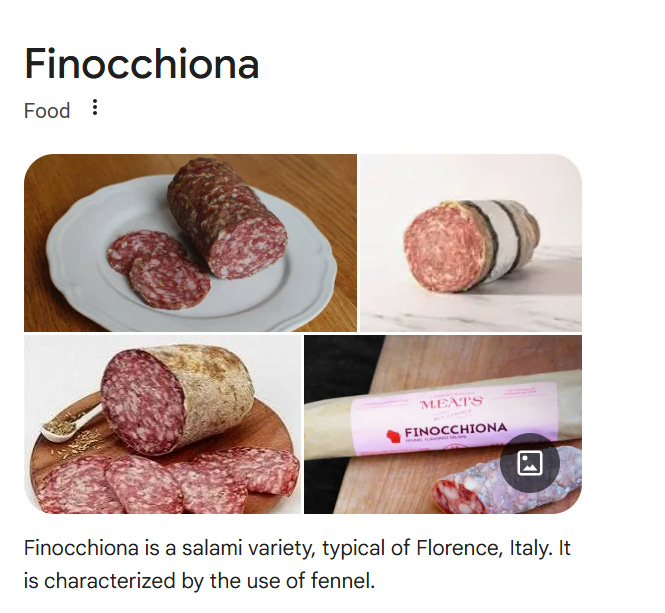
The draw of new restaurants like this is more ambiance than anything. A place to dress up, go out, bask in the glow of an intentional dining room before it eventually disappears in a few years when Green River Project LLC is no longer en vogue. There’s something vaguely juvenile about this current state of the industry, as though each new opening is plagued by the Millennial desire to “adult,” each restaurant eager to please both legacy media and 20-somethings with Beli accounts. I rode hard against Eel Bar, but it is a beautiful place to sit, to pretend you’re grown up, even though the chefs, the servers, the other patrons, the people on the street outside are all as young as you are, or, worse, pretending to be. In a restaurant culture plagued by sameness, though, an expensive chair is the bare minimum. When cutting edge aesthetic inspiration is constantly at your fingertips, it’s very easy to know what cocktails to feature, which pickled peppers to import, how many BPMs your playlist should average. What’s most difficult is to stand out.
While walking through the West Village on a Sunday, I asked Clare if we could stop in front of Wallsé. I’d been a few times, once when its menu was still set, and was shocked that it appeared to be shuttered. What a shame, I thought. We’d been to Cafe Sabarsky earlier in the year, which was delicious, but a bit contrived. You can only wait for your table inside the Neue Galerie corridor for so long before eager tourists hoping for a walk-in begin to upset you. Still, the Austrian food delighted us, specifically because it was different and appropriate. Eating pickled fish and dill in the dead of February on the Upper East Side is like having a hot dog at Citi Field.
But who has time to go all the way up there, not to mention the initial Resy stake out for a rare table? Not I, which is why I’d always preferred its lowkey West Village former cousin, which I’d momentarily mourned until realizing via Google Search that Wallsé is actually closed for business every Sunday. That alone is interesting. I filed this knowledge away in my brain, fears allayed.
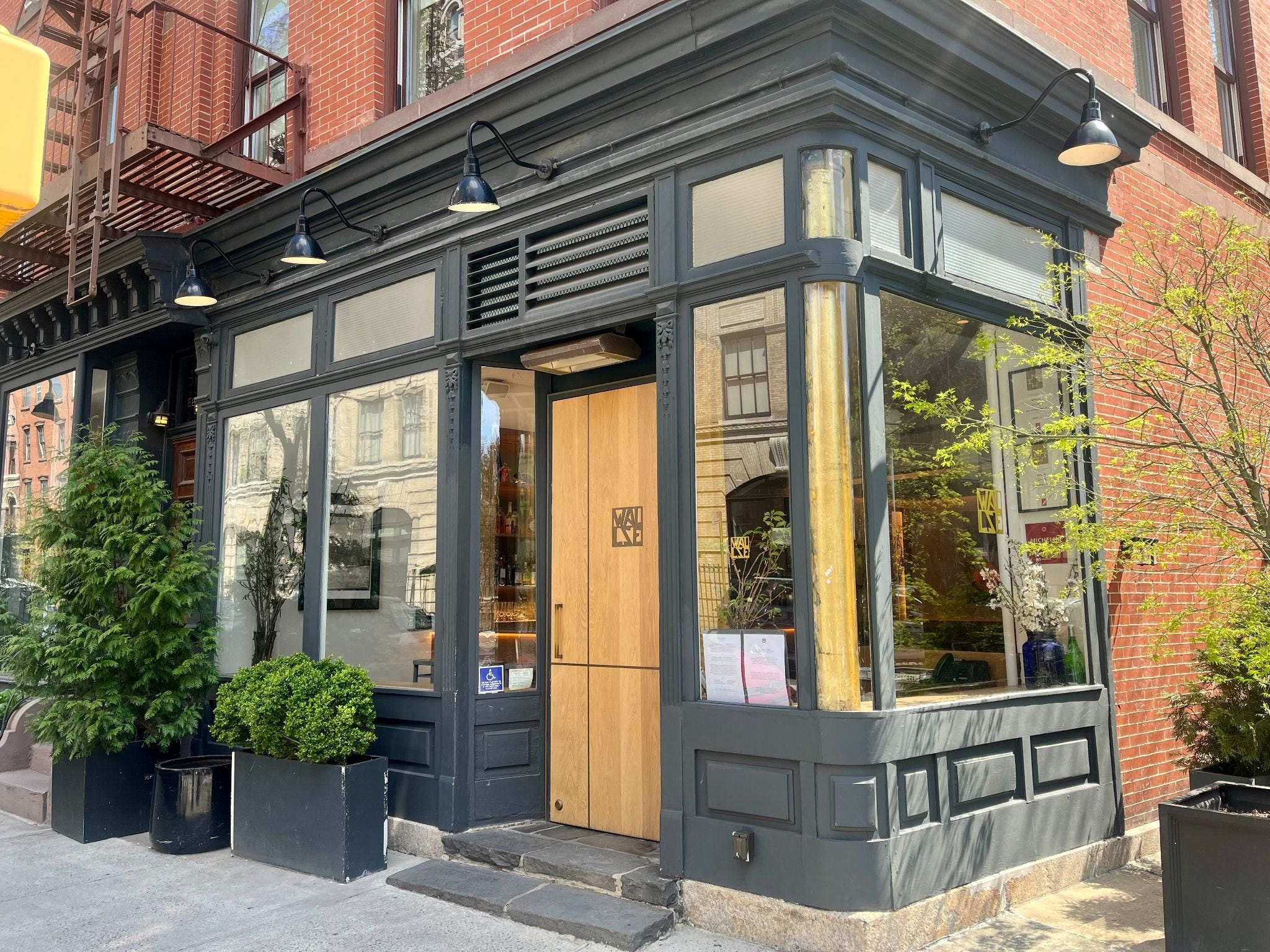
The following week, Clare and I decided to have an impromptu date night. I popped open the dreaded reservation apps, and showed her menu after menu. “These are all the same,” she said. And, she wasn’t wrong. Small plates, all with vegetables from the Union Square greenmarket. Maybe a pasta or two, handmade of course. While I was prepared to settle for something with a name like “Zimmi’s,” my own indifference pained me. $200 for a meal with plenty of butter and the perfect amount of kosher salt that I will also forget tomorrow: this is why people move to New York City. But then I remembered Wallsé, and this time it wasn’t Sunday.
We arrived slightly late, which I usually try to avoid, but it felt right. It was a breezy night, so a casual walk through the Village was in order: there’s nothing worse than showing up to a restaurant physically uncomfortable. The room was far from full when we arrived at 6:05 PM, its austere walls dotted with art, patrons of all ages quietly engaging in conversations to themselves. I wandered downstairs to the occupied bathroom and waited until a man in full Bavarian mountain garb exited, hat replete with feather. Authenticity signaled.
We settled into our corner table and took in our surroundings. I then noticed the soundtrack was tasteful classic rock standards: the Rolling Stones, Rod Stewart, Tom Petty. This was a welcome change of pace from someone’s painfully curated attempt at “cool” music. The chef and owner, Kurt Gutenbrunner surveyed the room beside us, and I could sense this was just what he enjoyed listening to. His confidence enveloped the space: we were in good hands.

To start, we ordered the “homemade” spiced rye bread with butter, the corn soup (offered hot or cold, ours the latter), and the beet salad. Every dish arrived unfussy but with an air of refined sophistication. Flavors aside, Wallsé is clearly German engineered.
I’ve found a great bread course to be somewhat essential in a restaurant which demands more time and money than a casual whim. This bread does not have to be free, it just has to be delicious, and worthy of table and stomach space. For instance, at Foul Witch, the semolina focaccia with cultured butter will draw you back time and again regardless of whatever other food you have there.
The bread at Wallsé is a level setter, an invitation to what will ensue. It’s simple, clearly Germanic, not necessarily fun, but still delicious. You will not want a second helping, but instead more food of the same genre. The corn soup is seasonal, but should it be on the menu in the late summer, order it cold even if fall weather is beginning to creep. It’s a light, sweet, thin porridge which reminds that the simplest, best ingredients often speak for themselves.
After bread and soup, the beets were our heartiest starter: dressed in walnuts, blackberries, blue cheese, and a blackcurrant sorbet. Spanning all temperatures, tastes, and textures that could possibly fit in a dish, let alone in one bite, this is a meal in itself: strange enough to savor, familiar enough to leave no crumb behind. It’s the perfect appetizer, and despite containing so much, still arrives on the plate as composed as everything else in the restaurant.

And it’s this composure that lends the restaurant its subsisting charm: larger dishes will not also be slopped on a platter “to share,” but look like dinner on your plate at a table in a restaurant. But there’s no pressure to order your own entree, so we still shared two more dishes and a few sides before dessert, and our server could not have cared less, instead only memorizing our initial order and making sure it came coursed accordingly without having to ask if we felt we had ordered enough, or if we wanted to determine the order in which we ate.
The smoked salmon and trumpet mushrooms arrived alongside two small but overflowing bowls of spätzle and potato salad. The fish was my favorite dish of the evening, served atop a crisp potato rösti with fennel, dill, and crème fraiche. It cut through the haze of early fall and dwindling daylight straight to the heart of winter, reminding me of the latkes I make for my family on Christmas Eve. Usually I reserve smoked salmon for bagels, chopped up inside lox spread, but now I’ve confidently found at least one worthy exception to weekend habit and familial tradition.
I also enjoyed the mushrooms, served slightly firm and buttery atop a large semolina dumpling. Like the smoked salmon, and even our sides, the dish transformed the mundane into something extraordinary. Many restaurants high and low use the same markets and purveyors, but post-purchase preparation and ideation leads to vastly different results. The majority of what so many restaurants now serve constitutes much of what we ordered: cured fish, cooked potato, foraged fungi, boiled dough. But our mushrooms tasted like mushrooms, not butter, nor salt, scattered artfully over a hand-formed dumpling as though waiting to be foraged by utensil.
For dessert, we enjoyed traditional Viennese pastries like one of Tilda Swinton’s characters in Luca Guadagnino’s Suspiria, a strange association between food and media I still strongly hold. But that makes me enjoy it slightly more: just transportative enough to make me appreciate the difference between “salzburger nockerl” and “blueberry custard cake,” or “apple strudel with schlag” versus mere “apple tarte with whipped cream.” Still, I know my appreciation of Wallsé isn’t driven by this association, because the food is terrific on its own.

But even if it were, that would be ok; a great restaurant, one for adults, invites association, and conversation, nearly everything a blank slate except for its food. The music is low enough to speak, the lights high enough to see. If you were to ask any Millennial what they love about, say, Rolo’s, they would be at a loss. “Uh, the food is awesome.” Oh, what about the food? Inventing a hook—“we make our own lunch meat in house”—is not a reason to bestow greatness. Jeremy Allen White’s favorite “neighborhood” restaurant is not cause célèbre, it’s just where he likes to go when he’s not working to talk to 24-year-olds who look like Rosalía. Because he played a chef on a Hulu show doesn’t change that. Should we start asking Bradley Cooper what his favorite neighborhood spot is? At least he actually owns a restaurant and even sometimes cooks there.
Having your expectations so far exceeded by food is now rare, and there has to be a line in the sand. The only “mature” restaurants cannot just be new ones contending for awards or stars or helmed by influencer-cum-chefs, nor can they be places where celebrities go, or wannabe celebrities consort. Perhaps what I’m describing in Wallsé is just a bit of old New York still lingering around the West Village: it opened in the early 2000s. One such other place for adults in similar and dissimilar ways is the resurrected Babbo, an even older restaurant now with fresh legs.1
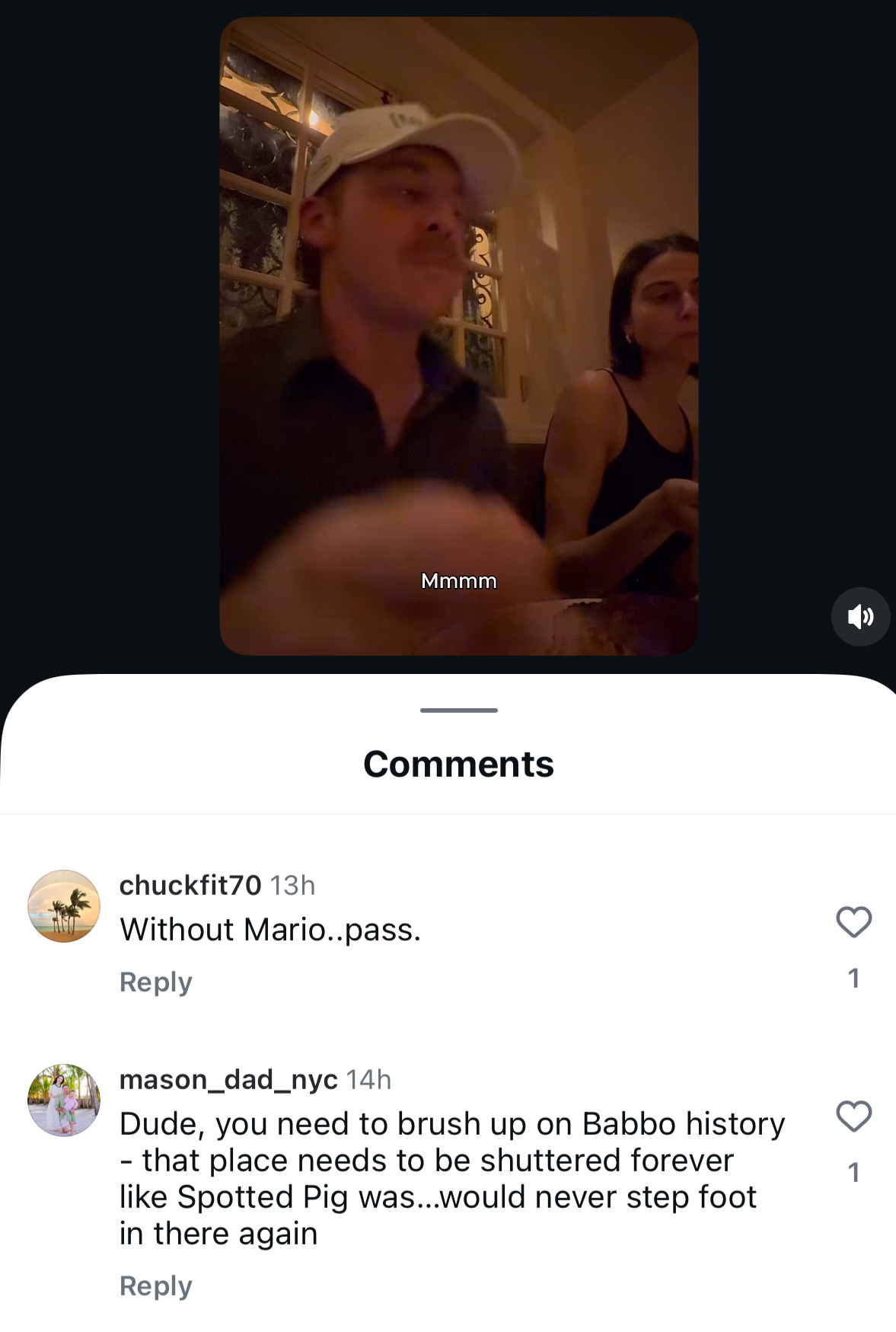
Maybe via shifting tides under a new mayor, New York City will undergo another dining sea change, sloppy plates giving way to a new intervention, only the best sticking around to weather changing tastes. But even then, two decades from now should a Shake Shack not replace it, Cervo’s will never be a restaurant for adults. On Feed Me’s new podcast Expense Account, Alison Roman detailed her last night there before COVID lockdown, making out with a stranger on line for the bathroom after “too many martinis.” There comes a point where you have to grow up, and for New York City’s hardest tables, time for doing so has passed. There’s a lot worth eating here, but you often have to chafe against the grain to find it. That can be uncomfortable, but no more so than iPhone camera flash in a dark, crowded restaurant.
More on that at a later date.
i want to go back when it's snowing #wallseplans
I would pay restaurants to turn their playlists off (considerably less if they only turn it down). I don't want to listen to their music when I eat out.
It was a revelation to eat in Vienna on my honeymoon. I didn't expect the cafes and restaurants to be so quiet. Even the tourist-traps didn't play music. It was enjoyable to eavesdrop and listen to silverware. In an odd way, I felt more connected to the people around me, or as you might put it, these Viennese cafes invited "association" to me with their regulars simply by not playing music. I can't say I've ever felt that at any "great" New York restaurant The Infatuation's promoted.